Why a Single Activity Felt a Little Thin
Yamakraft Blocks started life as a digital building-block app with careful physics. A 60Hz physics engine, friction and restitution tuned from real-world measurements, wood-on-wood collision sounds — as a digital block set, I think it held its own.
But when I thought carefully about how a family with a two- or three-year-old actually uses Montessori materials at home, a single activity started to feel a little thin. Montessori education is built around a small collection of sensory tools laid out on a shelf, with the child choosing which one to explore, then returning it when they’re done. That ritual of choosing and returning is a meaningful part of the learning itself. A child needs the space to ask themselves, “which one do I feel like today?”
So with the Phase F release in April 2026, Yamakraft Blocks grew from a block-stacking app into an app built around three toy boxes sitting on a shelf — a quiet set of sensory activities inspired by Montessori principles.
Three Toy Boxes, One Shelf
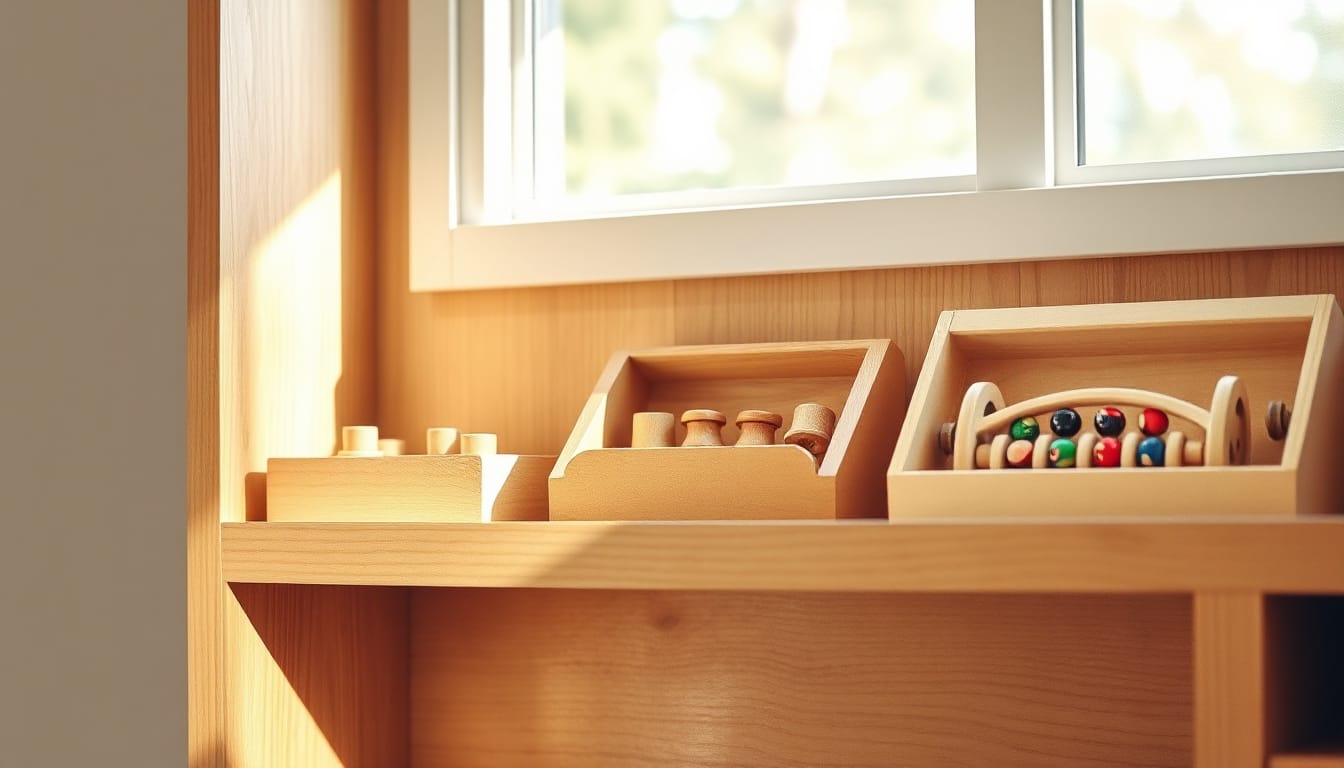
The app opens onto a two-tier wooden cabinet. Three toy boxes sit on the shelf.
1. Blocks
Nine shapes of blocks that the child can duplicate freely, stack, and knock over on a physics-driven surface. Wood grain, mass-aware behavior, wood-on-wood collision sounds. No score, no goal, no timer. Just stacking and knocking down, for as long as the child cares to.
2. Tone Bells
Inspired by the classic Montessori Bells Board — 8 fixed bells on the top row, 8 movable bells on the bottom, 16 in total. Because this is digital, the tuning stays perfect, always. No drift, no retuning, no worry about the pitch going off over time. Matching pitches, building pitch memory, gently exploring octaves.
3. Marble Track
Five piece types the child can arrange freely to guide a marble from top to bottom. Because it’s digital, pieces are unlimited and a failed attempt resets instantly. “If I arrange it this way, how will the marble move?” — this little loop of prediction and experimentation sits at the center of the activity, with no tidying-up afterwards.
A Shelf Ritual, Built Into the UX
The thing I’m most proud of in this release isn’t that we bundled three activities. It’s that we wove the Montessori-inspired ritual of taking a box off the shelf, playing, and returning it directly into the UX.
The flow goes like this:
- The app opens to the exterior of a wooden cabinet with toy boxes on it
- The child drags a box off the shelf to “take it out”
- They open the box and play with that activity
- When the session timer (visualized as falling leaves — no numbers) ends, the screen dims quietly
- The child returns the toy box to the shelf to end the session
The Montessori principles of choosing an activity, focusing, and putting it away are experienced through the gestures themselves — not through badges, scores, or flashy reward screens. None of that exists in this app.
Real Materials First, This App as a Quiet Companion
Physical Montessori materials have an advantage the digital world can’t match: real tactile feedback. The grain of wood, the ring of a metal bell, the weight of a marble in a small hand — none of that translates fully to a tablet, no matter how polished the graphics.
This app doesn’t try to replace them.
Instead, Yamakraft Blocks is designed as a quiet companion for moments when physical materials aren’t at hand:
- Travel, visits to grandparents, hotel rooms
- On the train, in the car
- Those few minutes when a parent can’t step away from housework
- Indoor days when outdoor play isn’t an option
When you want a child to focus on something, but not something game-like — that’s the gap this app hopes to fill, without compromising the principles that make Montessori materials valuable in the first place. No reward UI, no flashing stimuli, no gamification.
It stays in the same condition every time. It fits on a tablet. It resets instantly when things go wrong. Real wooden materials remain the primary experience. This app is a quiet assistant alongside them — never a replacement.
What’s Next
There’s still polish and work before release:
- Visual refinement (metallic highlights on the bells, wood grain details on the cabinet)
- On-device testing with real toddlers
- Replacing placeholder assets with carefully crafted illustrations and sounds
- Short introduction videos for each of the three activities
Wrapping Up
Yamakraft Blocks is no longer just a block-stacking app. It’s become an app built around three sensory activities — blocks, tone bells, and a marble track — wrapped in the gentle ritual of taking a box off the shelf and returning it when you’re done. Not a game, but a quiet activity, inspired by Montessori principles.
It won’t outdo real wooden materials. But for those moments on the go, in transit, or in the handful of minutes when a parent just can’t step away — I hope it can grow into a thoughtful companion for a child’s focus.
Polish work continues toward release. More soon.
